

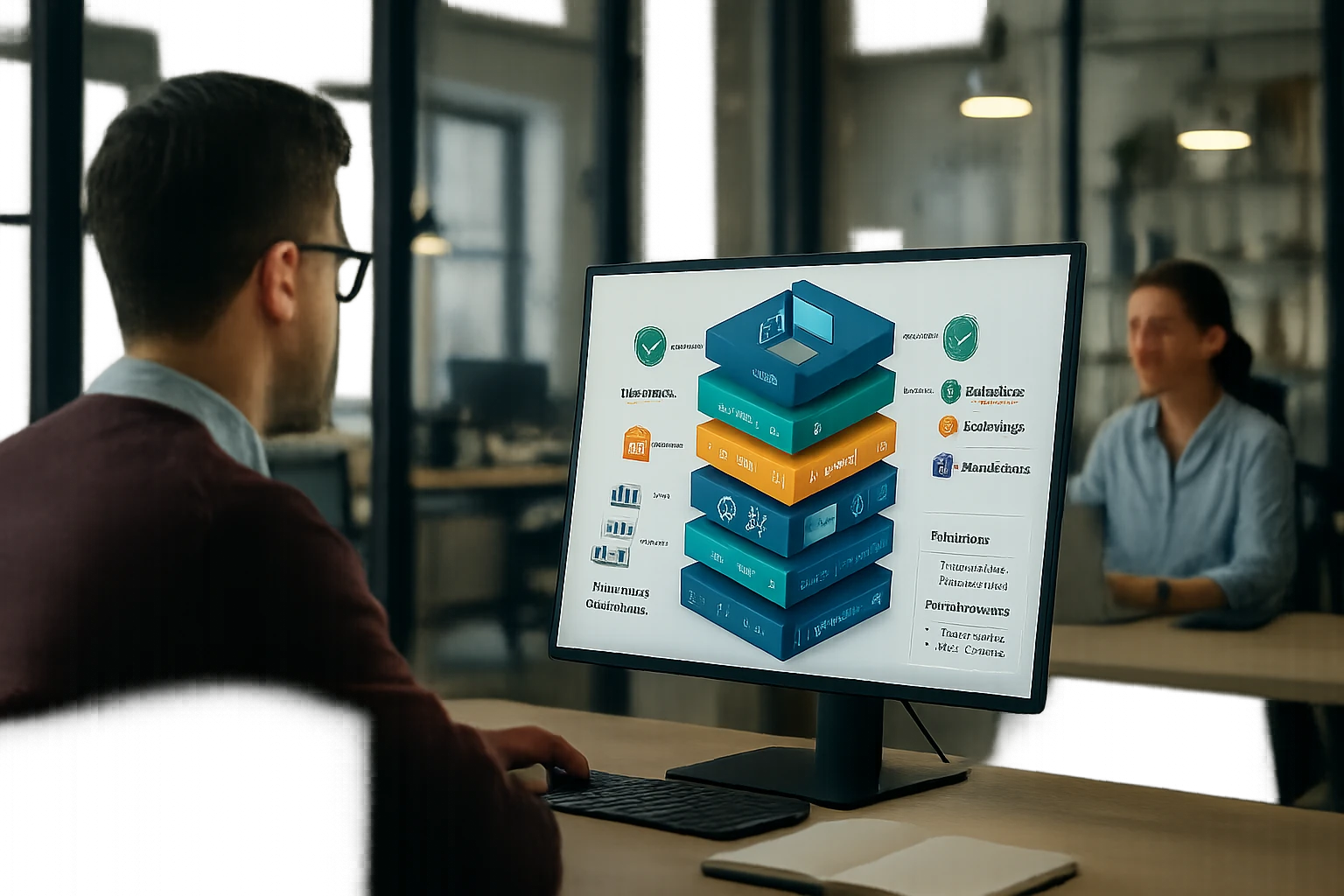
The world of information technology constantly evolves, yet one fundamental concept remains at its core: architecture. This topic fascinates because it represents the invisible foundation upon which our entire digital world operates. Every application you use, every website you visit, and every digital service you rely on exists because someone carefully designed its underlying structure.
Architecture in IT refers to the systematic organization and design of technology components, their relationships, and the principles governing their implementation. This encompasses everything from software applications to enterprise systems, defining how different parts communicate and work together. We'll explore this concept from multiple angles, examining both theoretical foundations and practical applications that shape modern technology.
Through this exploration, you'll gain a comprehensive understanding of IT architecture's various forms, from software and system architecture to enterprise and cloud-based approaches. You'll discover how architects make critical decisions, learn about essential patterns and frameworks, and understand why proper architectural planning determines the success or failure of technology initiatives.
What is IT Architecture?
IT architecture serves as the blueprint for technology systems, much like architectural plans guide building construction. It defines the structure, behavior, and relationships between different components within a technology ecosystem. This discipline combines technical expertise with strategic thinking to create solutions that meet both immediate needs and long-term objectives.
The concept encompasses multiple layers of abstraction, from high-level business requirements down to specific technical implementations. Architects must consider factors such as performance, security, scalability, and maintainability while balancing competing priorities and constraints.
Essential characteristics of IT architecture include:
• Structure – How components are organized and connected
• Behavior – How the system responds to various inputs and conditions
• Standards – Guidelines and principles that govern design decisions
• Documentation – Clear representation of the architectural vision
• Governance – Processes for maintaining architectural integrity
"Good architecture is not just about technology; it's about creating sustainable solutions that evolve with business needs while maintaining their fundamental integrity."
Types of IT Architecture
Software Architecture
Software architecture focuses on the internal structure of individual applications or systems. It defines how software components interact, the patterns they follow, and the principles that guide their organization. This type of architecture directly impacts code quality, maintainability, and the ability to implement new features.
Key considerations include choosing appropriate design patterns, defining clear interfaces between components, and establishing coding standards. Software architects must balance flexibility with performance, ensuring applications can adapt to changing requirements without sacrificing efficiency.
The most common software architectural patterns include layered architecture, microservices, event-driven architecture, and model-view-controller (MVC). Each pattern offers distinct advantages and trade-offs, making the selection process crucial for project success.
System Architecture
System architecture takes a broader view, encompassing multiple software applications, hardware components, and their interconnections. It addresses how different systems communicate, share data, and coordinate their activities to achieve business objectives.
This architectural level considers infrastructure requirements, network topology, security boundaries, and integration patterns. System architects must understand both technical capabilities and business processes to design effective solutions.
Modern system architecture increasingly emphasizes distributed computing, cloud integration, and API-first design approaches. These trends reflect the growing complexity of business requirements and the need for flexible, scalable solutions.
Enterprise Architecture
Enterprise architecture represents the highest level of architectural thinking, aligning technology investments with business strategy. It provides a comprehensive view of an organization's technology landscape, identifying opportunities for improvement and standardization.
This discipline involves multiple architectural domains: business architecture, information architecture, application architecture, and technology architecture. Each domain contributes to a holistic understanding of how technology supports organizational goals.
Enterprise architects must balance innovation with stability, ensuring new technologies integrate seamlessly with existing systems while supporting future growth. They also play a crucial role in technology governance, establishing standards and guidelines for architectural decisions across the organization.
Architectural Patterns and Frameworks
Common Design Patterns
Architectural patterns provide proven solutions to recurring design problems. These patterns have evolved through years of practical experience, offering tested approaches to common challenges in system design.
The layered architecture pattern organizes components into horizontal layers, each with specific responsibilities. This approach promotes separation of concerns and makes systems easier to understand and maintain. However, it can introduce performance overhead when data must pass through multiple layers.
Microservices architecture breaks applications into small, independent services that communicate through well-defined APIs. This pattern enables teams to develop, deploy, and scale services independently, but introduces complexity in service coordination and data consistency.
Event-driven architecture uses events to trigger communication between loosely coupled components. This pattern excels in scenarios requiring high scalability and real-time processing, though it can make system behavior more difficult to predict and debug.
Framework Selection Criteria
Choosing the right architectural framework requires careful consideration of multiple factors. Technical requirements, team expertise, project timeline, and long-term maintenance needs all influence this critical decision.
Performance requirements often dictate architectural choices, particularly for high-traffic applications or real-time systems. Some frameworks excel in specific performance scenarios while struggling in others, making thorough evaluation essential.
Team capabilities significantly impact framework success. The most elegant architectural solution becomes problematic if the development team lacks the necessary skills or experience to implement it effectively.
Maintenance and evolution considerations are equally important. Frameworks that seem attractive initially may prove difficult to modify or extend as requirements change over time.
| Pattern Type | Best Use Cases | Key Benefits | Main Challenges |
|---|---|---|---|
| Layered | Traditional enterprise applications | Clear separation of concerns, easy to understand | Potential performance overhead |
| Microservices | Large, complex applications with multiple teams | Independent deployment, technology diversity | Service coordination complexity |
| Event-Driven | Real-time systems, high scalability needs | Loose coupling, excellent scalability | Debugging complexity, eventual consistency |
| Monolithic | Simple applications, small teams | Easy deployment, straightforward debugging | Limited scalability, technology lock-in |
Key Components of IT Architecture
Infrastructure Components
Infrastructure forms the foundation of any IT architecture, encompassing servers, networks, storage systems, and the physical or virtual environments where applications operate. Modern infrastructure increasingly relies on cloud services, virtualization, and containerization technologies.
Compute resources provide the processing power necessary for applications to function. This includes traditional servers, virtual machines, and containerized environments. Architects must carefully size these resources based on expected workloads and growth projections.
Storage architecture determines how data is stored, accessed, and protected. Considerations include performance requirements, backup strategies, disaster recovery needs, and compliance obligations. Modern storage solutions often combine multiple technologies to optimize for different use cases.
Network design enables communication between system components and external users. This involves designing network topology, implementing security controls, and ensuring adequate bandwidth for expected traffic patterns.
Application Components
Application components represent the software elements that deliver business functionality. These components must be designed to work together efficiently while maintaining clear boundaries and responsibilities.
User interface components handle interaction with end users, presenting information and accepting input. Modern architectures often separate user interface logic from business logic, enabling multiple interface types (web, mobile, API) to share common functionality.
Business logic components implement the core functionality that delivers value to users. These components should be designed to be reusable, testable, and independent of specific user interface or data storage technologies.
Data access components manage interaction with databases and other data sources. Well-designed data access layers abstract the complexities of data storage from business logic, making applications more maintainable and portable.
"The best architectures are those that remain invisible to users while enabling developers to build robust, maintainable solutions efficiently."
Architecture Planning and Design Process
Requirements Analysis
Effective architectural planning begins with thorough requirements analysis. This process involves understanding both functional requirements (what the system must do) and non-functional requirements (how well it must perform). Architects must engage with stakeholders to uncover hidden assumptions and constraints that could impact design decisions.
Functional requirements define the specific capabilities the system must provide. These requirements directly influence architectural decisions about component organization, data flow, and user interaction patterns.
Non-functional requirements often have the greatest impact on architectural choices. Performance, security, scalability, and availability requirements can fundamentally shape system design, sometimes requiring significant trade-offs between competing objectives.
Constraint identification reveals limitations that must be accommodated in the architectural design. These might include budget restrictions, technology standards, regulatory requirements, or integration with existing systems.
Design Documentation
Architectural documentation serves multiple purposes: communicating design decisions, guiding implementation teams, and preserving knowledge for future maintenance and enhancement efforts. Effective documentation balances comprehensiveness with accessibility, providing the right level of detail for different audiences.
Architectural diagrams provide visual representations of system structure and relationships. Different diagram types serve different purposes, from high-level context diagrams to detailed component interaction diagrams.
Decision records document the reasoning behind important architectural choices. These records prove invaluable when revisiting design decisions or onboarding new team members who need to understand the system's evolution.
Interface specifications define how different components communicate with each other. Clear interface documentation reduces integration problems and enables teams to work independently on different system parts.
Modern Architecture Trends
Cloud-Native Architecture
Cloud-native architecture represents a fundamental shift in how applications are designed, built, and operated. This approach leverages cloud computing capabilities to create systems that are inherently scalable, resilient, and efficient.
Containerization enables applications to run consistently across different environments while maximizing resource utilization. Container orchestration platforms like Kubernetes provide sophisticated capabilities for managing containerized applications at scale.
Serverless computing abstracts infrastructure management entirely, allowing developers to focus purely on business logic. This approach can significantly reduce operational overhead while providing automatic scaling capabilities.
API-first design ensures that all functionality is accessible through well-defined interfaces, enabling integration with various clients and third-party services. This approach supports the composable, interconnected systems that characterize modern architectures.
DevOps Integration
Modern architecture cannot be separated from operational considerations. DevOps practices fundamentally influence architectural decisions, emphasizing automation, monitoring, and rapid iteration capabilities.
Continuous integration and deployment require architectures that support automated testing and deployment processes. This often means designing systems with clear component boundaries and comprehensive test coverage.
Infrastructure as code treats infrastructure configuration as software, enabling version control, automated provisioning, and consistent environment management. This approach requires architects to consider how infrastructure changes will be managed throughout the system lifecycle.
Observability becomes crucial in complex, distributed systems. Architectures must incorporate comprehensive logging, monitoring, and tracing capabilities from the beginning, not as an afterthought.
| Architecture Type | Key Characteristics | Primary Benefits | Implementation Complexity |
|---|---|---|---|
| Monolithic | Single deployable unit | Simple deployment, easy debugging | Low to Medium |
| Microservices | Distributed, independent services | Scalability, technology diversity | High |
| Serverless | Function-based, event-driven | Cost efficiency, automatic scaling | Medium |
| Hybrid | Combination of multiple approaches | Flexibility, gradual migration | High |
Architecture Governance and Standards
Establishing Governance Frameworks
Architecture governance ensures that design decisions align with organizational objectives and technical standards. This involves establishing processes, roles, and criteria for evaluating and approving architectural proposals.
Architecture review boards provide oversight for significant architectural decisions, ensuring consistency across projects and alignment with enterprise standards. These boards typically include senior architects, technical leaders, and business stakeholders.
Design standards establish consistent approaches to common architectural challenges. Standards might cover areas such as security implementation, data management, user interface design, or integration patterns.
Exception processes handle situations where standard approaches don't fit specific requirements. Well-designed governance frameworks include mechanisms for requesting and evaluating exceptions without compromising overall architectural integrity.
Quality Assurance
Architectural quality assurance goes beyond traditional testing to evaluate whether implemented systems meet their architectural intent. This involves both automated checks and manual reviews of architectural compliance.
Architecture conformance checking uses automated tools to verify that implemented code follows established architectural patterns and constraints. These tools can detect violations of layering rules, dependency constraints, or naming conventions.
Performance validation ensures that systems meet their non-functional requirements under realistic conditions. This often involves load testing, stress testing, and monitoring of production systems to validate architectural assumptions.
Security reviews evaluate whether security controls are properly implemented according to architectural specifications. This includes both technical security measures and adherence to security policies and procedures.
"Governance is not about restricting creativity; it's about providing guardrails that enable teams to innovate safely within established boundaries."
Common Architecture Challenges
Scalability Issues
Scalability challenges arise when systems must handle increasing loads without proportional increases in resource consumption or response times. These challenges often become apparent only after systems are deployed in production environments.
Horizontal scaling involves adding more servers or instances to handle increased load. This approach requires architectures that can distribute work effectively across multiple resources and handle the complexities of distributed computing.
Vertical scaling increases the capacity of existing resources by adding more CPU, memory, or storage. While simpler to implement, this approach has practical limits and can create single points of failure.
Database scaling presents particular challenges because traditional relational databases weren't designed for distributed operation. Solutions include read replicas, sharding, and alternative database technologies designed for distributed environments.
Integration Complexity
Modern systems rarely operate in isolation, requiring integration with numerous external services, legacy systems, and third-party applications. This integration complexity can quickly overwhelm poorly designed architectures.
API management becomes crucial as the number of integrations grows. This includes designing consistent API interfaces, implementing security controls, managing API versions, and monitoring API performance and usage.
Data consistency challenges arise when information must be synchronized across multiple systems with different data models and update patterns. Solutions range from real-time synchronization to eventual consistency models.
Error handling becomes more complex in integrated environments where failures can cascade across system boundaries. Robust architectures implement circuit breakers, retry mechanisms, and graceful degradation strategies.
Legacy System Modernization
Many organizations struggle with modernizing legacy systems that are critical to business operations but difficult to modify or integrate with modern technologies. This challenge requires careful architectural planning to minimize risk while enabling innovation.
Strangler fig pattern enables gradual replacement of legacy systems by incrementally routing functionality to new implementations. This approach reduces risk but requires careful planning to maintain system integrity during the transition.
API wrapping provides modern interfaces to legacy systems without requiring internal modifications. This approach enables integration with modern systems while preserving existing functionality and avoiding risky changes to stable systems.
Data migration strategies must address how to move data from legacy systems to modern platforms while maintaining data integrity and minimizing downtime. This often involves complex data transformation and validation processes.
Performance and Security Considerations
Performance Optimization
Performance considerations must be integrated into architectural design from the beginning, as retrofitting performance improvements into poorly designed systems is often difficult or impossible.
Caching strategies can dramatically improve system performance by storing frequently accessed data in fast-access storage. However, caching introduces complexity around cache invalidation and data consistency that must be carefully managed.
Load balancing distributes incoming requests across multiple server instances to prevent any single instance from becoming a bottleneck. Different load balancing strategies suit different application types and traffic patterns.
Database optimization involves both schema design and query optimization. Proper indexing, normalization decisions, and query patterns can mean the difference between acceptable and unacceptable performance.
Security Architecture
Security must be considered at every architectural level, from individual components to system-wide policies and procedures. Security cannot be an afterthought but must be integrated into the fundamental design of systems.
Defense in depth implements multiple layers of security controls, ensuring that the failure of any single control doesn't compromise the entire system. This approach requires careful coordination between different security mechanisms.
Identity and access management controls who can access what resources under what circumstances. Modern architectures often implement sophisticated identity systems that support single sign-on, multi-factor authentication, and fine-grained authorization controls.
Data protection encompasses both data at rest and data in transit. This includes encryption, access controls, data masking, and secure data disposal practices. Different types of data may require different protection levels based on sensitivity and regulatory requirements.
"Security is not a feature to be added later; it's a fundamental architectural principle that must be woven into every design decision."
Future of IT Architecture
Emerging Technologies
The IT architecture landscape continues to evolve rapidly, driven by emerging technologies that create new possibilities and challenges for system designers.
Artificial intelligence and machine learning are increasingly integrated into mainstream applications, requiring architectures that can handle the unique requirements of AI workloads, including specialized hardware, large datasets, and model management.
Edge computing brings processing closer to data sources and users, reducing latency and bandwidth requirements. This trend requires rethinking traditional centralized architectures to support distributed processing and intermittent connectivity.
Quantum computing remains largely experimental but promises to revolutionize certain types of computational problems. Forward-thinking architects are beginning to consider how quantum capabilities might integrate with classical computing systems.
Evolution of Architectural Practices
Architectural practices continue to evolve in response to changing business needs, technological capabilities, and lessons learned from both successes and failures in the field.
Architecture as code treats architectural specifications as software artifacts that can be version controlled, tested, and automatically validated. This approach enables more rigorous architectural governance and better alignment between design intent and implementation reality.
Evolutionary architecture explicitly designs systems to accommodate change over time. This approach recognizes that requirements will evolve and builds mechanisms for adaptation into the fundamental structure of systems.
Sustainable architecture considers the environmental impact of technology decisions, optimizing for energy efficiency and resource utilization. This trend reflects growing awareness of technology's environmental footprint and the need for more sustainable practices.
"The future belongs to architectures that can adapt and evolve while maintaining their essential characteristics and serving their intended purposes."
FAQ
What is the difference between system architecture and software architecture?
Software architecture focuses on the internal structure of individual applications, defining how components within a single software system interact. System architecture takes a broader view, encompassing multiple applications, hardware components, and their interconnections across an entire technology ecosystem.
How do you choose the right architectural pattern for a project?
Pattern selection depends on multiple factors including performance requirements, team expertise, scalability needs, and maintenance considerations. Evaluate each pattern's trade-offs against your specific requirements, considering both immediate needs and long-term evolution plans.
What role does cloud computing play in modern IT architecture?
Cloud computing fundamentally changes architectural approaches by providing on-demand resources, managed services, and global scalability. Modern architectures increasingly leverage cloud-native patterns like microservices, serverless computing, and API-first design to maximize cloud benefits.
How important is documentation in IT architecture?
Architectural documentation is crucial for communicating design decisions, guiding implementation teams, and preserving knowledge for future maintenance. Good documentation balances comprehensiveness with accessibility, providing appropriate detail levels for different audiences.
What are the biggest challenges in enterprise architecture?
Common challenges include legacy system integration, balancing innovation with stability, managing technical debt, ensuring security across complex systems, and aligning technology investments with business strategy. Success requires both technical expertise and strong stakeholder communication skills.
How do you measure architectural success?
Architectural success can be measured through various metrics including system performance, development velocity, maintenance costs, security incident frequency, and business objective achievement. The specific metrics depend on the architectural goals and organizational priorities established at the project's beginning.