
The translation lookaside buffer represents one of the most fascinating yet often overlooked components in modern computer architecture. While most people focus on CPU cores and RAM capacity when evaluating system performance, the TLB quietly operates behind the scenes, making virtual memory translation lightning-fast and enabling the seamless multitasking we take for granted today.
At its core, the translation lookaside buffer is a specialized cache that stores recent virtual-to-physical address translations, dramatically reducing the time needed for memory access operations. This comprehensive exploration will examine the TLB from multiple angles – its technical implementation, performance implications, design variations, and real-world impact on system efficiency.
By understanding how TLBs function and interact with other memory subsystems, you'll gain valuable insights into why some applications perform better than others, how operating systems optimize memory management, and what factors influence overall system responsiveness. Whether you're troubleshooting performance issues or simply curious about the intricate mechanisms that power modern computing, this deep dive will provide the knowledge you need.
Understanding Virtual Memory Translation
Virtual memory serves as the foundation for modern operating systems, providing each process with its own isolated address space while efficiently managing physical memory resources. When a program requests data from memory, it uses virtual addresses that must be translated to actual physical locations in RAM.
This translation process traditionally requires consulting page tables stored in main memory. Without optimization, every memory access would require multiple additional memory reads just to determine where the data actually resides.
The page table walk process can involve several levels of indirection, particularly on 64-bit systems where hierarchical page tables are common. Each level requires a separate memory access, creating significant overhead that would severely impact system performance.
The Translation Process Without TLB
When the processor needs to access memory without TLB assistance, it must perform a complete page table walk. This involves reading multiple page table entries from memory, starting with the top-level page directory.
For a typical x86-64 system, this process requires accessing four different page table levels. Each access takes time, and the cumulative effect creates substantial latency for every memory operation.
Modern applications frequently access scattered memory locations, making this overhead particularly problematic. Database systems, web browsers, and multimedia applications would suffer dramatic performance degradation without efficient address translation mechanisms.
TLB Architecture and Design
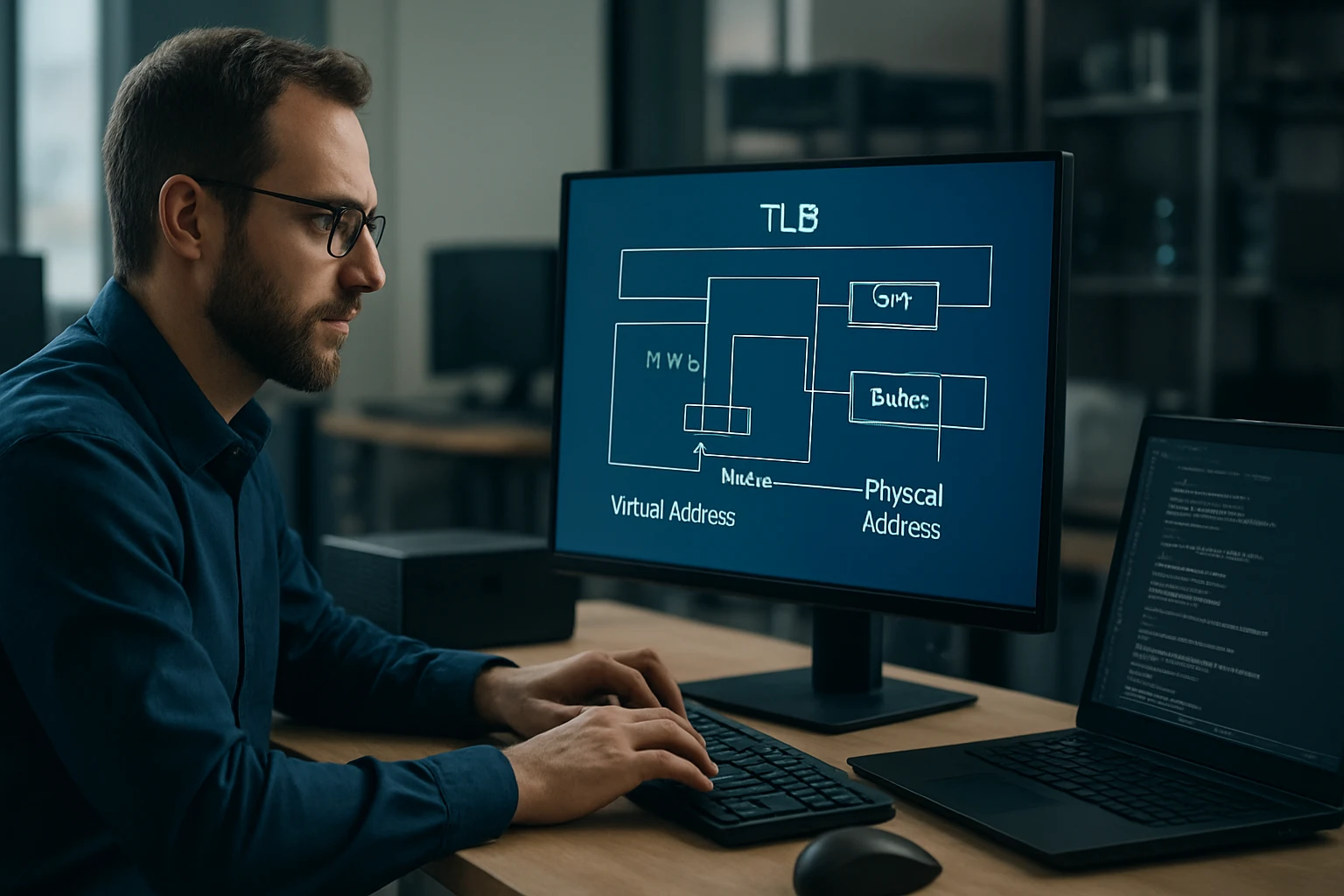
The translation lookaside buffer functions as a specialized associative cache designed specifically for address translation entries. Unlike general-purpose caches that store data, TLBs store mapping information between virtual and physical addresses.
Most TLB implementations use fully associative or set-associative organization. This design allows the TLB to quickly search all entries simultaneously, finding the appropriate translation in a single clock cycle when the entry exists.
"The efficiency of virtual memory systems depends entirely on the locality of reference and the ability to cache translation information effectively."
TLB Entry Structure
Each TLB entry contains several critical components that enable fast and secure address translation. The virtual page number serves as the search key, while the physical frame number provides the translation target.
Additional fields include protection bits that specify read, write, and execute permissions for the page. These bits enable the processor to enforce memory protection policies without additional memory accesses.
The valid bit indicates whether the entry contains current translation information. When this bit is clear, the processor knows it must perform a page table walk to obtain the correct translation.
| TLB Entry Component | Purpose | Typical Size |
|---|---|---|
| Virtual Page Number | Search key for translation | 20-52 bits |
| Physical Frame Number | Target address translation | 20-40 bits |
| Protection Bits | Access permissions (R/W/X) | 3-4 bits |
| Valid Bit | Entry validity indicator | 1 bit |
| Dirty Bit | Page modification status | 1 bit |
| ASID/PCID | Process identification | 8-12 bits |
Multi-Level TLB Hierarchies
Modern processors often implement multiple TLB levels to balance speed, capacity, and power consumption. The first-level TLBs (L1 TLB) are small but extremely fast, providing single-cycle access for the most recently used translations.
Second-level TLBs (L2 TLB) offer larger capacity with slightly higher access latency. This hierarchical approach mirrors the design philosophy used in data cache systems, optimizing for common access patterns.
Some advanced processors include separate TLBs for instruction and data accesses. This separation allows simultaneous translation lookups for instruction fetch and data operations, improving overall pipeline efficiency.
TLB Operation and Hit/Miss Scenarios
When the processor needs to translate a virtual address, it first checks the TLB for a matching entry. The virtual page number is extracted from the address and compared against all TLB entries simultaneously.
A TLB hit occurs when a matching entry is found, allowing immediate translation to the physical address. This scenario provides optimal performance, completing the translation in a single processor cycle.
TLB misses trigger more complex handling procedures that vary depending on the processor architecture and operating system design. The system must then perform a page table walk to obtain the correct translation.
TLB Hit Processing
During a TLB hit, the processor retrieves the physical frame number from the matching entry and combines it with the page offset from the original virtual address. This operation happens in parallel with other processor activities, minimizing impact on execution speed.
The protection bits are simultaneously checked to ensure the requested access type is permitted. If a protection violation occurs, the processor generates an exception even though the translation was found in the TLB.
Recent access information may be updated to support replacement algorithms when the TLB becomes full. This bookkeeping ensures that the most valuable translations remain available for future references.
TLB Miss Handling Strategies
Different processor architectures handle TLB misses through various mechanisms, each with distinct performance characteristics and implementation complexity. Hardware-managed TLBs automatically perform page table walks when misses occur.
Software-managed TLBs generate exceptions that transfer control to operating system handlers. These handlers must locate the correct translation and update the TLB before resuming normal execution.
"The choice between hardware and software TLB management represents a fundamental trade-off between processor complexity and operating system flexibility."
Hybrid approaches combine elements of both strategies, using hardware assistance for common cases while allowing software intervention for complex scenarios or special page types.
Performance Impact and Optimization
TLB performance directly affects overall system responsiveness, particularly for applications with diverse memory access patterns. High TLB hit rates enable efficient memory operations, while frequent misses can create significant performance bottlenecks.
The relationship between TLB size, associativity, and application behavior determines the effectiveness of address translation caching. Larger TLBs can store more translations but may require longer search times or more complex hardware.
Working set characteristics play a crucial role in TLB effectiveness. Applications that access memory within a limited range of pages achieve better TLB performance than those with scattered access patterns.
TLB Performance Metrics
Several key metrics help evaluate TLB effectiveness and identify optimization opportunities. The TLB hit rate represents the percentage of address translations found in the cache without requiring page table walks.
Miss penalty measures the additional time required when TLB entries are not available. This penalty includes both the page table walk time and any associated cache pollution effects.
Coverage represents the total amount of memory that can be addressed through current TLB entries. Higher coverage reduces the likelihood of misses for applications with large working sets.
| Performance Metric | Description | Typical Range |
|---|---|---|
| Hit Rate | Percentage of successful TLB lookups | 95-99.9% |
| Miss Penalty | Additional cycles for page table walk | 20-200 cycles |
| Coverage | Memory addressable through TLB | 2-512 MB |
| Access Time | Cycles for TLB lookup | 1-3 cycles |
Application-Specific Considerations
Database management systems often exhibit challenging TLB behavior due to their large working sets and random access patterns. These applications benefit from larger TLBs or specialized optimization techniques.
Scientific computing applications may show more predictable access patterns that work well with standard TLB configurations. However, large dataset processing can still create coverage challenges.
"Understanding application memory access patterns is essential for predicting and optimizing TLB performance in real-world scenarios."
Web servers and multimedia applications present unique challenges with their mix of code execution, data processing, and network buffer management. These diverse workloads require balanced TLB designs that handle multiple access types effectively.
TLB Coherency and Consistency
Maintaining consistency between TLBs and page tables presents significant challenges in modern systems. When the operating system modifies page table entries, corresponding TLB entries must be invalidated to prevent stale translations.
TLB shootdown procedures coordinate invalidation across multiple processor cores in symmetric multiprocessing systems. These operations ensure that all processors see consistent memory mappings after page table changes.
The timing and scope of TLB invalidation operations affect both correctness and performance. Aggressive invalidation ensures consistency but may unnecessarily flush useful entries, while conservative approaches risk using outdated translations.
Multi-Core TLB Management
Symmetric multiprocessing systems require sophisticated TLB management to maintain memory consistency across all processor cores. Inter-processor interrupts coordinate invalidation operations when one core modifies shared page tables.
Tagged TLBs use address space identifiers to distinguish between different processes or virtual machines. This tagging reduces the need for complete TLB flushes during context switches, improving overall system efficiency.
Some architectures implement TLB coherency protocols similar to cache coherency mechanisms. These protocols automatically maintain consistency without explicit software intervention, reducing operating system complexity.
Context Switching Implications
Process context switches traditionally require complete TLB invalidation to prevent cross-process address translation errors. This invalidation creates a cold start period where the new process must repopulate its TLB entries.
Address space identifiers allow TLB entries from multiple processes to coexist simultaneously. When switching contexts, only entries with mismatched identifiers need invalidation, preserving useful translations.
"Efficient context switching mechanisms can dramatically improve system responsiveness by minimizing TLB-related overhead during process transitions."
Virtual machine environments add additional complexity layers, requiring nested TLB management for both guest and host address spaces. Hardware virtualization support helps optimize these scenarios through specialized TLB handling mechanisms.
Advanced TLB Features and Innovations
Modern TLB implementations incorporate sophisticated features that extend beyond basic address translation caching. Large page support allows single TLB entries to cover megabyte or gigabyte-sized memory regions.
Prefetching mechanisms attempt to predict future translation needs and proactively load TLB entries before they are required. These techniques can reduce miss rates for applications with predictable access patterns.
Adaptive replacement policies monitor access patterns and adjust TLB management strategies accordingly. Machine learning approaches may eventually enable even more sophisticated optimization techniques.
Large Page Support
Large pages reduce TLB pressure by covering more memory with fewer entries. A single large page entry can replace dozens or hundreds of regular page entries, dramatically improving TLB efficiency for appropriate applications.
Operating system support for large pages requires careful memory allocation and management strategies. Not all applications benefit from large pages, and inappropriate usage can actually harm performance.
Transparent large page mechanisms attempt to automatically identify opportunities for large page usage. These systems balance the benefits of improved TLB performance against potential memory fragmentation issues.
Specialized TLB Designs
Some processors implement separate TLBs for different types of memory accesses or address spaces. Instruction TLBs optimize for code execution patterns, while data TLBs focus on variable access behaviors.
Graphics processors often include specialized TLBs designed for texture mapping and framebuffer operations. These TLBs may support different page sizes or replacement policies optimized for graphics workloads.
"Specialized TLB designs demonstrate how architecture-specific optimizations can significantly improve performance for targeted application domains."
Network processors and embedded systems may implement simplified TLB designs that trade functionality for reduced power consumption or silicon area. These designs reflect the specific requirements and constraints of their target environments.
TLB in Different Processor Architectures
Various processor architectures implement TLB functionality through different approaches, each reflecting the design philosophy and target applications of the architecture. x86 processors traditionally use hardware-managed TLBs with complex page table walking capabilities.
ARM architectures often employ software-managed TLBs that provide greater flexibility at the cost of increased operating system complexity. This approach allows customized handling for different memory types and usage patterns.
RISC-V implementations vary widely, with some designs using hardware management while others rely on software handlers. This flexibility reflects the architecture's emphasis on customization for specific application domains.
x86 TLB Implementation
Intel and AMD processors implement sophisticated multi-level TLB hierarchies with separate instruction and data TLBs at the first level. These designs optimize for the diverse workloads common in general-purpose computing environments.
The x86 architecture supports multiple page sizes simultaneously, requiring TLB designs that can handle 4KB, 2MB, and 1GB pages efficiently. This flexibility enables optimization for both fine-grained and large-scale memory usage patterns.
Hardware page table walking in x86 processors reduces operating system overhead but requires complex hardware implementations. The processor automatically handles most TLB miss scenarios without software intervention.
ARM TLB Characteristics
ARM processors often use unified TLBs that handle both instruction and data translations through a single structure. This approach simplifies hardware design while maintaining good performance for typical embedded and mobile workloads.
The ARM architecture's emphasis on power efficiency influences TLB design choices, favoring simpler implementations that consume less energy. Software-managed TLBs allow fine-tuned power management strategies.
Recent ARM designs incorporate more sophisticated TLB features to support server and high-performance computing applications. These enhancements include larger capacities and hardware-assisted management capabilities.
Debugging and Performance Analysis
Understanding TLB behavior requires specialized tools and techniques that can monitor address translation performance without significantly impacting system operation. Hardware performance counters provide detailed statistics about TLB hits, misses, and related metrics.
Profiling tools can identify applications or code sections that experience poor TLB performance, enabling targeted optimization efforts. These tools often integrate TLB analysis with broader memory system performance evaluation.
Simulation environments allow detailed TLB behavior analysis under controlled conditions. These simulations can evaluate different TLB configurations and predict performance impacts of architectural changes.
Performance Counter Analysis
Most modern processors provide performance counters that track TLB-related events with minimal overhead. These counters can measure hit rates, miss penalties, and other key metrics during normal system operation.
Counter-based analysis helps identify performance bottlenecks and validate optimization strategies. Regular monitoring can detect changes in application behavior that affect TLB performance over time.
"Effective performance analysis requires combining multiple measurement techniques to build a comprehensive understanding of TLB behavior and its system-wide impacts."
Automated analysis tools can process performance counter data to identify patterns and suggest optimization opportunities. These tools often integrate with broader system performance management frameworks.
Optimization Strategies
Application-level optimizations can improve TLB performance through better memory layout and access pattern design. Data structure organization and algorithm selection significantly influence translation cache effectiveness.
Operating system tuning options include page size selection, memory allocation policies, and TLB management parameter adjustment. These system-level optimizations can benefit multiple applications simultaneously.
Compiler optimizations may improve TLB performance through code layout modifications and memory access pattern improvements. Profile-guided optimization can tailor these improvements to specific application characteristics.
What is a Translation Lookaside Buffer (TLB)?
A Translation Lookaside Buffer is a specialized cache that stores recent virtual-to-physical address translations, enabling fast memory access by avoiding repeated page table lookups. It acts as a high-speed lookup table that dramatically reduces the time needed for address translation in virtual memory systems.
How does TLB improve system performance?
TLB improves performance by caching frequently used address translations, reducing the need for time-consuming page table walks. When a translation is found in the TLB (a hit), the address conversion happens in a single cycle instead of requiring multiple memory accesses to traverse page table structures.
What happens during a TLB miss?
During a TLB miss, the processor must perform a page table walk to find the correct virtual-to-physical address mapping. This involves reading multiple levels of page tables from main memory, which takes significantly longer than a TLB hit. The resulting translation is then stored in the TLB for future use.
Why do different applications have varying TLB performance?
Applications with different memory access patterns experience varying TLB performance. Programs that access memory within a small, localized range achieve high hit rates, while applications that randomly access large amounts of memory may experience frequent misses due to limited TLB capacity and coverage.
How do large pages affect TLB efficiency?
Large pages improve TLB efficiency by allowing each entry to cover more memory space. Instead of using multiple TLB entries for small 4KB pages, a single entry can cover a 2MB or 1GB large page, effectively increasing the TLB's coverage and reducing miss rates for applications with large working sets.
What is TLB shootdown in multi-core systems?
TLB shootdown is a coordination mechanism used in multi-core systems to maintain memory consistency. When one processor core modifies page table entries, it sends inter-processor interrupts to other cores, forcing them to invalidate potentially stale TLB entries to ensure all cores see consistent memory mappings.